
The AI Efficiency Trap: How to Use AI in Marketing Without Losing Your Brand Voice

Simply put, AI should make good marketing faster. It cannot make unclear marketing good.
When I review a brand, I use one quick test: the “Could It Be Anyone” test. If the logo disappeared, would anyone still know it’s you?
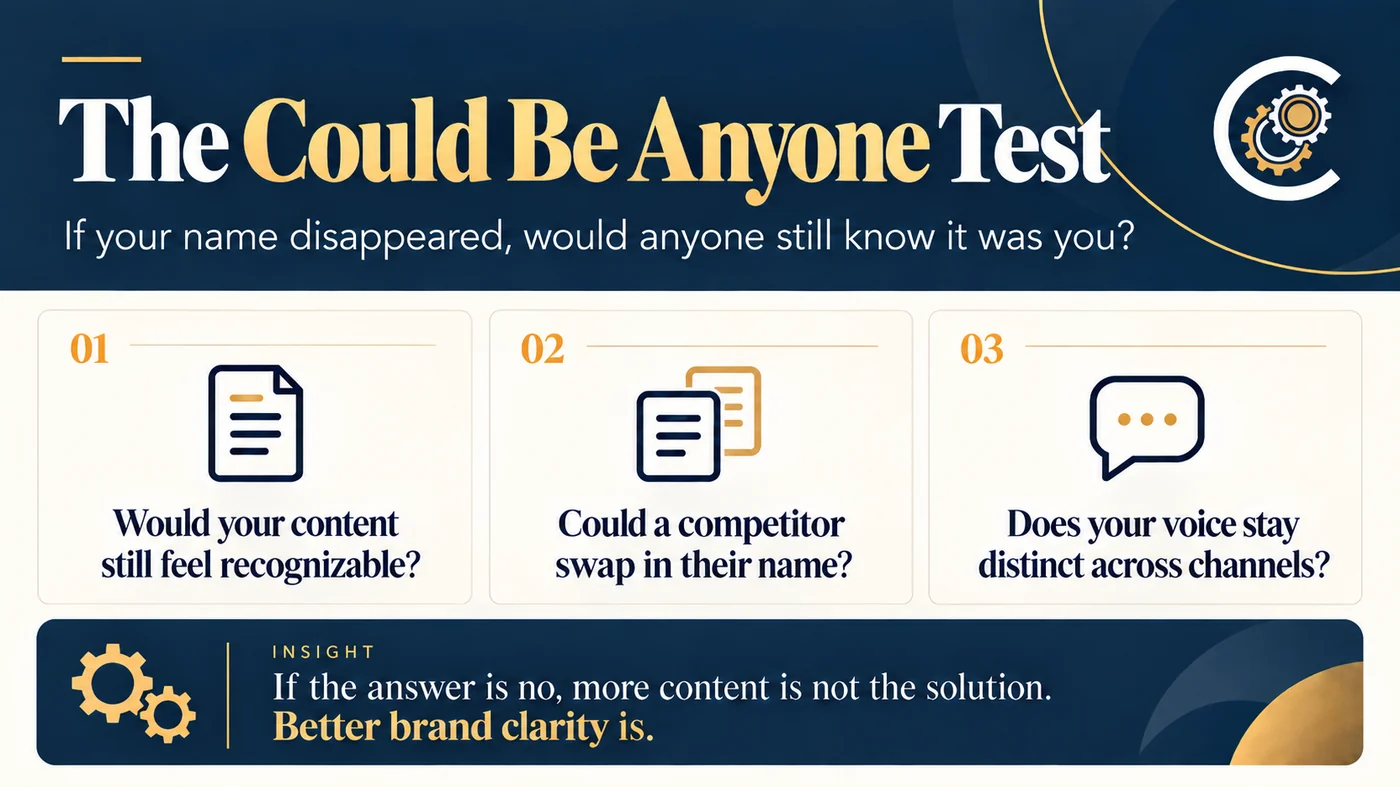
Yes, AI has removed much of the friction from producing marketing materials at scale. Still, it hasn’t removed the need to decide what a company should say, why anyone should care, or which ideas deserve amplification. We can train it, argue with it, and use it for brainstorming when we feel a little stuck in the mud. But it can’t replace the emotional chord your brand was built to strike with customers.
Before it goes out the door, content validation should pass the “without my logo” test. Be honest with yourself and your brand. Step outside the business; pretend you are your customer.
- Does the messaging and creative make sense, or do you need more context?
- Does it enlighten or entertain?
- What value will the person — not the bot — on the other end gain for giving your brand at least three seconds of their life?
AI might research, compare and recommend for us, but brands still need to build trust, clarity and differentiation to make customers confident choosing them. Not just through a single search, but multiple times across the squiggly lines that make up a customer journey.
For DTC, consumer journeys vary widely by category, consideration level and channel. I’ve seen as few as two touchpoints and as many as eleven. For B2B, McKinsey recently published data stating that buyers use an average of 10 channels or touchpoints. Modern buying journeys rarely happen in a single interaction. Buyers move between search, social, websites, reviews, sales conversations and increasingly AI-assisted research before a human makes the final decision.
At some point, the buyer is still asking a very human question: can I trust these people to understand my problem and help me solve it?
Those are the moments when human judgment matters most. The person writing the brief, approving the work or protecting the reputation still owns the responsibility to the brand and the customer. Those are the critical moments when we need to drop the “A” and realize “I” have an obligation to this brand and to my customers to keep it real.
The business risk is not simply publishing a clumsy AI-written paragraph. The larger risk is building an efficient content operation that produces more assets, consumes more channels, and still gives buyers no distinct reason to remember or choose your brand.
What is the AI efficiency trap?
The AI efficiency trap occurs when a company mistakes faster marketing production for better marketing performance. Output rises, production time falls and the team appears more productive. But qualified demand, conversion, brand recognition or customer preference may not improve.
The dashboard can look busy while the business remains stuck. Red flags might look like:
- More articles, emails and social posts without more qualified opportunities.
- Shorter production cycles without stronger campaign performance.
- More message variations without a clearer market position.
- Lower content costs paired with weaker editorial standards.
- Higher publishing frequency without increased brand recall or direct demand.
- Teams measuring output because they have not agreed on the business outcome, or on what performance really looks like.
Efficiency matters. We’re all finding ourselves doing more with less. The mistake is treating efficiency as the strategy rather than as one input into a strategy.
“The dashboard can look busy while the business remains stuck.”
Why AI-assisted marketing often sounds the same
Generative models are designed to produce plausible patterns from the material and instructions they receive. When companies provide generic prompts, thin brand guidelines and undifferentiated source material, the resulting content will often be polished but familiar. It looks and acts like the industry you’re in, not the brand you’re building.
Sameness usually enters the workflow before the first draft. It happens when:
- The team asks AI to write before deciding what the company believes.
- The prompt describes a format but not a defensible point of view.
- It lacks insight only you can glean from real data that sits behind your firewall.
- Brand guidance lists adjectives instead of showing how the brand thinks and speaks.
- Competitor content becomes the primary research material.
- Human review corrects grammar but does not challenge the idea.
- Volume targets reward completion rather than usefulness or distinction.
HubSpot reported in 2026 that 61% of marketers considered expressing a brand point of view critical when working with AI. That emphasis is logical: when production tools become widely available, the scarce advantage is no longer access to the tool. What cannot be replicated so easily is the accumulated judgment that comes from building a business or brand — the customer conversations, mistakes, wins and pattern recognition earned over six months or sixty years.
What AI should not decide
AI can inform decisions, but accountability for those decisions should remain with people who understand the company, its customers and the consequences of being wrong. The short list of things not to assign to AI:
- Which customer or market matters most. You ground that with data and insight.
- What problem the company is uniquely qualified to solve.
- What the brand believes that competitors do not.
- Which claims the business can prove.
- Which trade-offs the company is willing to make.
- What should not be published.
- When empathy, discretion or first-hand experience matters more than speed.
These are leadership decisions. Automating them without a clear owner can make an organization faster at executing an unclear or undifferentiated strategy — one that may not connect to the financial goals driving revenue outcomes.
What AI can accelerate responsibly
Once the strategic boundaries are clear, AI can remove substantial production friction. Useful applications include:
- Synthesizing approved research and customer inputs.
- Identifying common questions, objections and search patterns.
- Organizing a content brief or first-pass outline.
- Generating headline and message variations for human evaluation.
- Repurposing an original article into channel-specific formats.
- Auditing content inventories and identifying gaps or duplication.
- Comparing recurring competitor themes without copying their language.
- Preparing metadata, structured content and quality-control checklists.
- Connecting creative and project-management tools to synthesize processes.
The dividing line: use AI to accelerate work you already understand. Don’t use it to disguise the fact that nobody has made the strategic decision yet.
The Calibrate human-led AI loop
A reliable AI workflow makes ownership obvious. Humans set the strategy and standards. AI accelerates defined production work. Humans verify the output. The market tells you whether it worked. Those results inform the next decision.
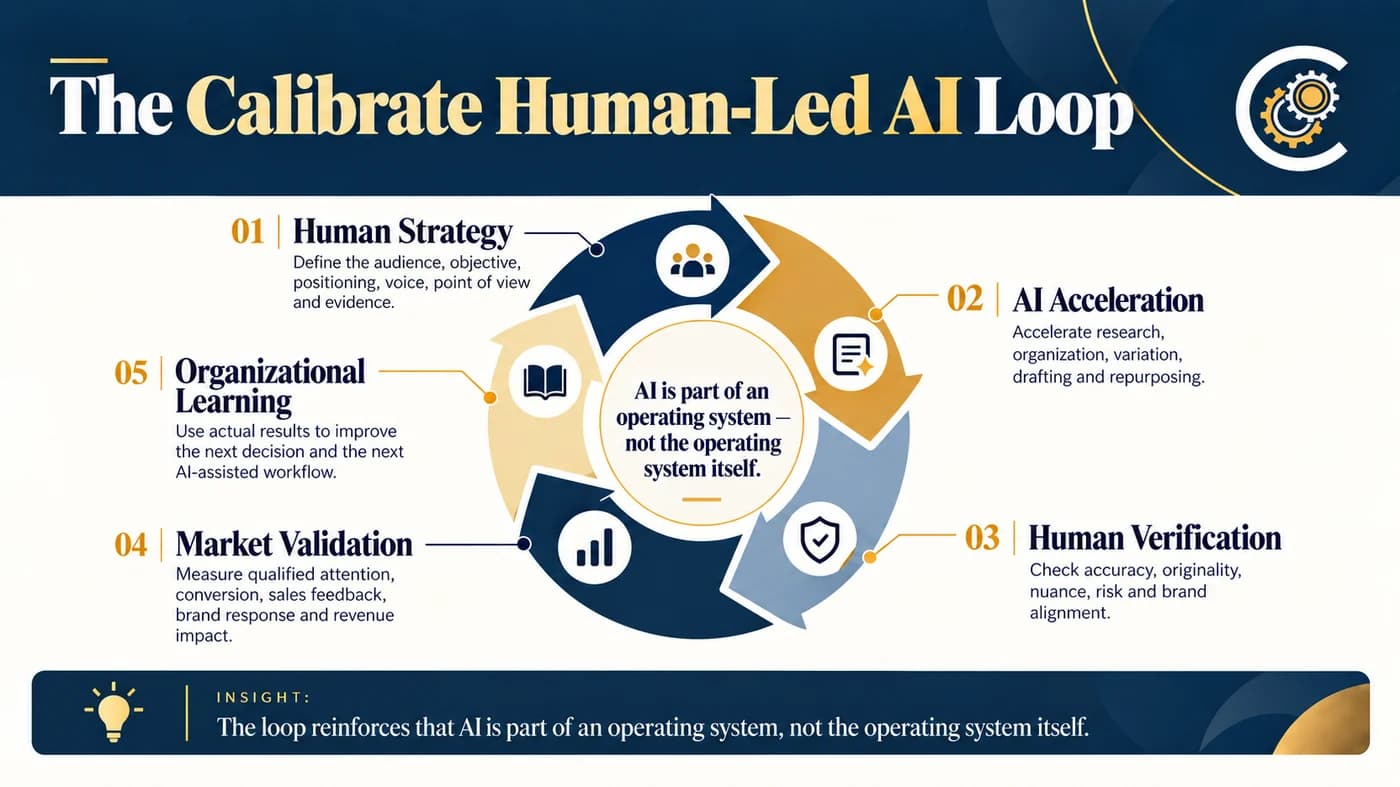
Step 1: Human strategy
Begin with a written decision about the audience, business objective, market position, brand tone and voice, message and evidence. A prompt cannot compensate for disagreement at this stage. If leadership and marketing cannot explain what the company wants to be known for, AI will usually fill the gap with category conventions.
Step 2: AI-assisted production
Give the system approved source material, examples, constraints, intended reader, business objective and channel context. Ask it to validate your data and insight against industry benchmarks. Request sources, assumptions, alternatives and areas of uncertainty.
Step 3: Human verification
A qualified reviewer should verify facts, claims, citations, tone, originality and appropriateness. Review should also ask a harder question: does this say something useful and recognizable, or does it merely sound complete?
Step 4: Market validation
Evaluate the work using business measures appropriate to its purpose. That may include qualified traffic, engagement from the intended audience, assisted conversion, sales use, pipeline influence, direct searches or customer feedback. Production volume is an operating metric, not proof of marketing value.
Step 5: Organizational learning
Feed the results back into the strategy, prompts, approved evidence and editorial standards. The goal is not to create a static prompt library. It is to build a system that learns from customers and informs how to improve the quality of future decisions.
Why original expertise matters for SEO and AI search
Publishing more derivative summaries does not give a search engine or answer engine a strong reason to surface, quote or cite the brand. Original value is more likely to come from first-hand experience, named expertise, proprietary frameworks, documented outcomes, useful comparisons, and clear opinions supported by evidence — not just what has been recently created under an AI-optimized lens.
According to NP Digital, the average cited content age is 2.5 to 3.5 years, which suggests quality outlasts freshness, based on its research into generative engine optimization and AI search behaviour.
Google says that using generative AI does not automatically violate its search guidelines. The concern is using automation primarily to manipulate rankings or create low-value content at scale. Its people-first guidance continues to emphasize original information, substantial value, clear authorship and content created to help the intended audience. The principles behind E-E-A-T haven’t disappeared: experience, expertise, authority and trust still matter.
For AI discovery, distinctiveness also improves clarity. A company that consistently explains what it does, whom it helps, what it believes and how it supports its claims is easier for both people and machines to interpret than a company publishing large amounts of interchangeable category content. That is the same principle behind making your business discoverable in AI search.
How to tell whether AI is weakening your brand
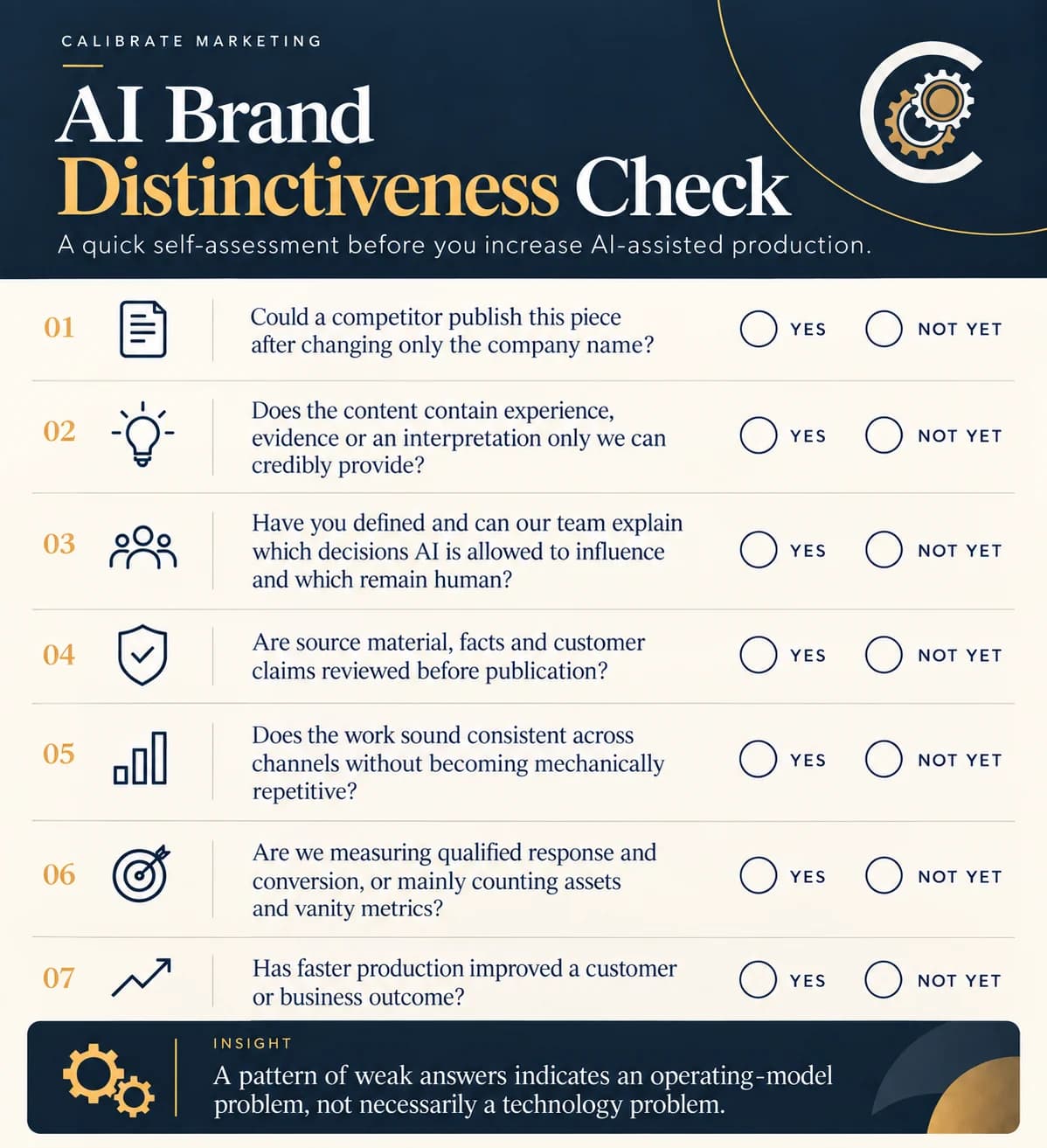
Marketing leaders can use the following diagnostic before increasing AI-assisted production:
- Could a competitor publish this piece after changing only the company name?
- Does the content contain experience, evidence or an interpretation only we can credibly provide?
- Have you defined, and can our team explain, which decisions AI is allowed to influence and which remain human?
- Are source material, facts and customer claims reviewed before publication?
- Does the work sound consistent across channels without becoming mechanically repetitive?
- Are we measuring qualified response and conversion, or mainly counting assets and vanity metrics?
- Has faster production improved a customer or business outcome?
A pattern of weak answers indicates an operating-model problem, not necessarily a technology problem. Share this with the marketing leaders in your network for a quick assessment:
What an AI content governance standard should include
Governance does not need to become a web of unnecessary red tape that slows down the very thing you built efficiency around. It should make ownership, accountability and acceptable use clear enough that teams can move quickly without improvising the rules on every project.
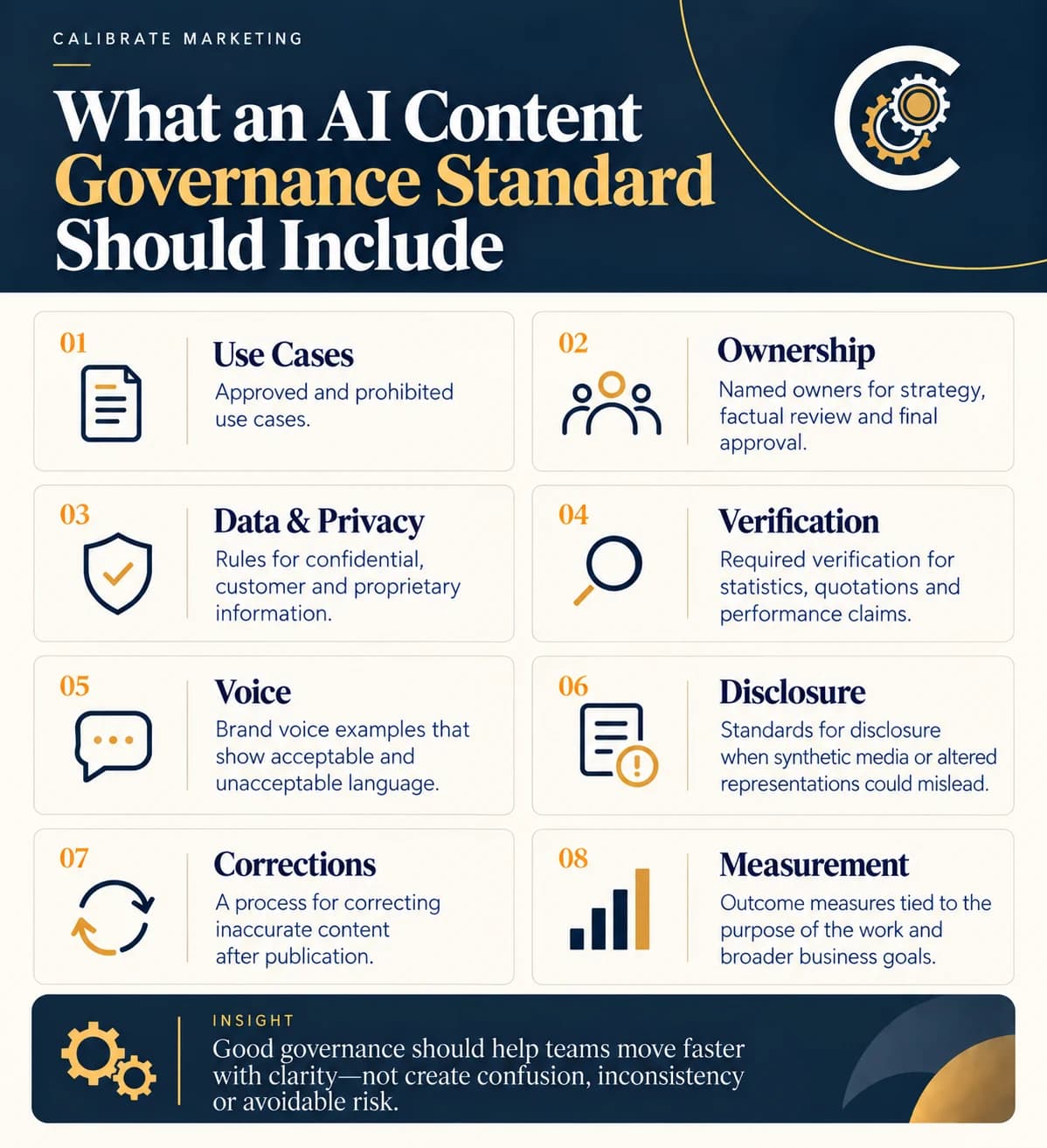
- Approved and prohibited use cases.
- Named owners for strategy, factual review and final approval.
- Rules for confidential, customer and proprietary information.
- Required verification for statistics, quotations and performance claims.
- Brand voice examples that show acceptable and unacceptable language.
- Standards for disclosure when synthetic media or altered representations could mislead.
- A process for correcting inaccurate content after publication.
- Outcome measures tied to the purpose of the work and to broader business goals.
When the problem is larger than content
If these symptoms are showing up across teams, channels or vendors, the issue may be larger than content. The underlying problem may be unclear positioning, fragmented ownership, weak customer insight, inconsistent evidence, or the absence of a senior leader connecting activity to business priorities.
That’s when the answer is not another prompt or platform. The company may need a focused strategy sprint, a clearer brand and content system, realignment around a value proposition tied to customer insight, or fractional leadership that can align the team and the measurement around one growth plan.
About Calibrate Marketing
Calibrate Marketing is led by Maria Sweeney, a Boston-area marketing executive with more than 20 years of experience across B2B, B2C, D2C, CPG, SaaS, health technology and professional services.
Calibrate helps small and mid-market businesses, growth-stage companies and private-equity-backed organizations connect brand, growth strategy, digital execution and AI-enabled marketing. The work combines executive judgment with practical implementation, so efficiency does not come at the expense of clarity, credibility or performance. See how engagements work.
Frequently asked questions
How can a company use AI without losing its brand voice?
Define the audience, positioning, point of view, approved evidence and voice standards before using AI for production. Provide source material and constraints, then require a qualified human to verify accuracy, originality and brand alignment before publication.
Does Google penalize AI-generated content?
Google states that appropriate use of AI is not against its guidelines. Content created primarily to manipulate search rankings may violate spam policies. The practical standard is whether the page offers original, accurate and useful value to its intended audience.
What marketing work should remain human?
People should retain accountability for audience selection, positioning, claims, tradeoffs, sensitive communication, final approval and business measurement. AI can support those decisions but should not become the unaccountable owner of them.
What is AI content governance?
AI content governance is the set of owners, rules, source requirements, privacy controls, review standards and correction processes that guide how a company uses AI in marketing.
How do you measure whether AI improves marketing?
Compare business outcomes before and after the workflow change. Useful measures may include cycle time, production cost, qualified engagement, conversion, sales adoption, pipeline influence, direct demand and correction rates. More output alone does not establish better performance.
Can AI help with SEO and GEO?
Yes. AI can assist with research, question discovery, content structure, metadata, internal-link planning and content audits. The published work still needs accurate information, original value, clear authorship and strong alignment with reader intent.
When should a company bring in a fractional CMO for AI strategy?
Consider fractional leadership when AI use spans multiple teams or vendors, no one owns the operating model, content volume is rising without results, brand standards are inconsistent or leadership needs a measurable plan connecting AI investment to growth.

Written by Maria Sweeney, a Boston-based fractional CMO. Over twenty years inside global brands — thirteen of them at Hasbro — now spent helping small and growth-stage companies. More about Maria's background.
Sound like your situation?
If any of this landed close to home, that's usually worth a conversation. No pitch — just a straight read on where you are.